|
The name Corfu or Corifo comes from the ancient saying "city of the Mountain point" because of the two hills that stand in the land. Corfu used to have many names in the past like scythe, because it looked like a scythe, or Makria (it means long in Greek), because the island is long, or Kassiopia, Keraina, Arpi und Sheria, like Homer used to call it. The mythology mentions that the island got its name from the nymph Kerkyra, whom Poseidon brought to the island. The fruit of their love was Faiakas, ancestor of the ancient Faiakes, people who according to Homer, offered hospitality to Ulysses before he arrived in
Ithace.
|
The known Homeric
hero arrives, exhausted after many adventuries, in the
island where Nausica - the daughter of the King of Faiakes
Alkinoos - finds him and brings him to the rich palace
of her father, where he is offered the best hospitality
and honors that are suitable for all strangers.
The mythical ancestors of the inhabitants of Corfu are
present in Homer's Epic as the founders of a great technological
civilization with the best equipped navy and a democratical
organized society. However, it is not verified from
the archaeology yet.
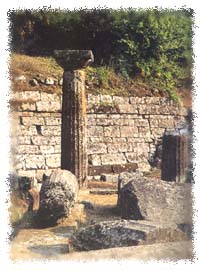
On the contrary there are findings that reveal the existence
of inhabitants since the Stone Age (in Agios Mathaios)
and the neo- Stone Ago (in Sidari) and in the Copper
Age (in Kefali, Amfioenes).
|
|
The first Greeks who arrived in the island came from Eretria,
Evia (775-750 BC). Later it was inhabited by the Corithians (735
BC). They built the ancient city and the acropolis, that exists
today in the Analipsis. Soon enough Corfu became a great commercial
power with a powerful navy. It founded its own Collonies and it
became independent from Corinth. This rich island, in the following
years, was the apple of discord between the two powerful states
of that time, Athens and Sparta.
Later, the island was under the Macedonian protection and it prospered
until it was seized by the Tyrant of Syracuse and later by the
King of Epirus, Pyrros. Nevertheless, soon enough the island finally
passes to the Romans (229 BC). In this time Corfu looses its power
and the privileges of its people.
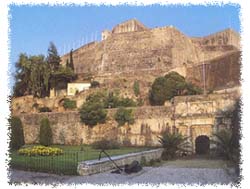 |
In the Byzantine
times the adventures of Corfu continued, with many successive
conquerors, while its defense was enforced by the entrenchment
of the new city and the old fortress. Many barbarians
seized the island and destroyed it. In the beginning
of the 11th century the Normans conquered the island
while soon it passes back to the Byzantines with Venetians
on their side, in 1386.
The island remains to Venetians until 1797, after they
have successfully confronted the Turkish efforts to
conclude Corfu in Ottoman Empire. They also prevented
the uprising of the folk people, who were opposed to
pay to the landed class.
|
In 1797 Corfu was conquered by France. The French were not the
saviors that the island was hoping for. They supported the royal
class by imposing more taxes. They were proved to be more barbarian
than the previous conquerors. They looted the churches and the
fortresses carrying all the loot to their country. Two years later
the Russian- Turkish fleet conquered the island and in 1800 the
Ionian Islands were recognized as an autonomous Greek state, that
has to pay taxes to Turkey.
That was the core from where the revival of the Greek nation started.
In 1806 the French returned, this time they were creating and
not destructing. This time they build new fortresses for the city,
they plant many trees and they build big, imposing buildings.
They emphasized on agriculture and education by founding the Ionian
Academy, in 1808, with its valuable contribution to the Greek
arts. In the vortex of the English- French conflict, and after
the fall of Napoleon, Corfu, along with the rest of the Ionian
islands, passes to the English domination, in 1814, who did not
protect the inhabitants of Corfu but were cruel to those who were
against the status-quo. They were merciless to the Freedom Party
of Greeks in 1821, as well as to the unification of the Ionian
islands with the newly-established Greek state.
 |
The British occupation
also had positive effects, like the development of the
economy, while they promoted the education and the Greek
language as the official language of the island. In
1824 the New Ionian Academy was build, which was the
first Greek University by which some of the most spiritual
people were pushed forward, like: Andreas Kalvos, Petros
Vrailas and some more.
Parallel
revival is observed in the Arts with the foundation
of the first Greek Art school, in 1815, by the famous
Paul Prosalentis, as well as the foundation of musical
societies and lyric theatres.
|
In 1864 this island was given as a "gift" to the new King of Greece,
George I, by the protecting Powers. After its union with Greece,
Corfu looses its spiritual avant-garde but the economy prospers
due to the creation of the big market. The agriculture is modernized
and boosts the industry. During World War I, the ally troops seized
Corfu and used it as a base until the end of the war.
During World War II, Corfu was conquered first by the Italians
and then by the Germans who burned and destroyed houses, historical
and architectural monuments and valuable cultural treasures were
transformed to ruins. In 1944, people with persistence and love
for Corfu, managed to bring back its grandeur, making it one of
the cosmopolitan resorts in the Mediterranean Sea.
|


